
Online Payment Gateways in Morocco: CMI, Attijari Payment, Chaabi Payment, Wallets and COD Compared
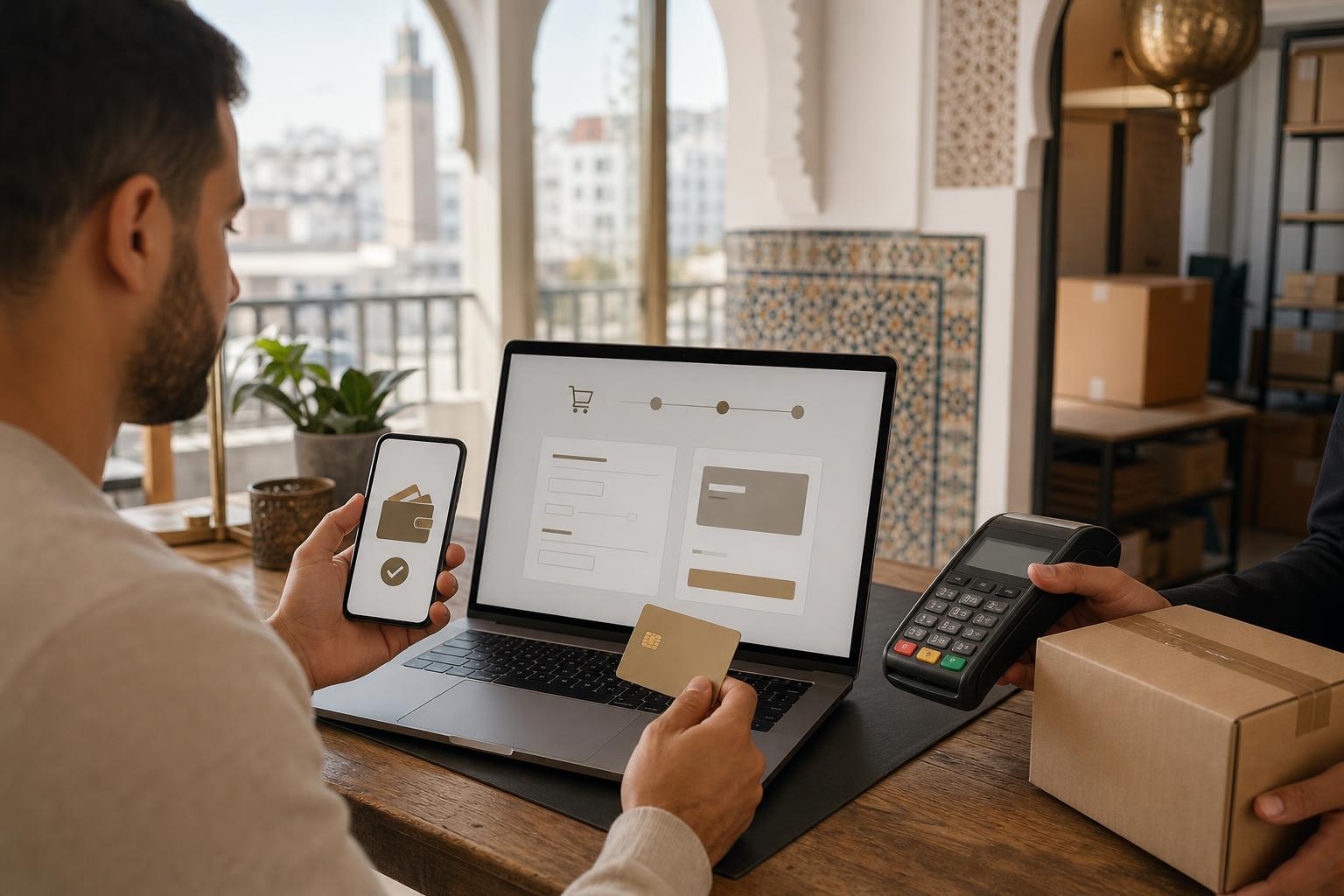
Choosing an online payment gateway in Morocco is not simply a technical decision. It affects customer trust, checkout completion, accounting, refunds, fraud management and the ability to sell internationally. The right setup depends on your business model, legal structure, average order value, target markets and delivery process.
Moroccan merchants commonly evaluate CMI, payment services connected to Attijariwafa bank or Banque Populaire, mobile wallets and cash on delivery (COD). These options are not interchangeable: each addresses different customer habits and operational needs. Before launching a store through a professional website creation service, it is worth defining which methods belong in the first release and which can be added later.
How online payments generally work in Morocco
A typical card payment involves the merchant’s website, a payment interface, an acquiring or banking partner and the cardholder’s bank. During checkout, the customer is redirected to a hosted payment page or interacts with a securely embedded interface. The payment is then authorized, declined or left pending, and the merchant’s system receives a status notification.
Commercial access normally requires a registered business, a business bank account and supporting documents. Providers may also review the website, products, refund policy, delivery terms and expected transaction profile. Fees, settlement schedules, accepted cards and technical requirements depend on the contract and can change, so merchants should request a current written offer rather than relying on an old price list.
CMI: a familiar card-payment route
CMI is one of the best-known names associated with online card acceptance in Morocco. For many local e-commerce projects, it is among the first options considered because Moroccan customers may already recognize the payment journey.
Where CMI can fit well
- Moroccan stores that primarily charge customers in the local market.
- Businesses seeking card acceptance through an established domestic ecosystem.
- Websites that can implement server-side payment verification and order-status updates.
- Merchants prepared to complete contractual, banking and compliance onboarding.
Points to verify before signing
Ask which domestic and international cards are supported, how settlements work, whether recurring or tokenized payments are available for your use case, and how refunds and cancellations are handled. You should also confirm the test environment, production activation process, notification mechanism and support arrangements.
A robust integration should never mark an order as paid solely because the browser returns to a success page. Proper web development verifies the transaction through the provider’s trusted server-side response and handles duplicate, delayed or failed notifications safely.
Attijari Payment and the Attijariwafa bank ecosystem
Businesses banking with Attijariwafa bank may explore the institution’s merchant-acquiring and digital-payment options. “Attijari Payment” is often used conversationally to describe this broader route, but the exact contractual entity, gateway, eligibility rules and available functions should be confirmed directly with the bank or payment representative.
This option may be attractive when a company wants its payment collection and business banking relationship within the same group. That can simplify commercial discussions, account settlement and administrative follow-up. However, convenience should not replace a technical comparison.
Questions for the commercial and technical teams
- Which cards, currencies and customer locations can be accepted?
- Are payments hosted, embedded or available through an API?
- What are the setup, transaction, refund and recurring charges?
- When are funds settled, and how are reconciliations exported?
- Is there a sandbox with complete and current documentation?
- How are disputes, fraud alerts and unsuccessful payments managed?
Chaabi Payment and Banque Populaire options
Merchants with Banque Populaire accounts may similarly consider payment services offered through its banking and payment ecosystem. The label “Chaabi Payment” can refer to different commercial journeys or services, so businesses should identify the exact product and contracting party being proposed.
A bank-aligned solution may suit an established Moroccan company that values branch access, an existing account relationship or consolidated financial operations. Its suitability still depends on integration quality, supported transaction types, settlement terms and customer experience.
Do not choose only on the basis of your current bank. Request technical documentation and compare the complete cost of operation, including development, testing, reconciliation, refunds and support. Checkout clarity also matters: expert UI/UX design can reduce confusion without hiding fees or important conditions.
Mobile wallets: useful, but audience-dependent
Mobile wallets allow customers to pay from an account or wallet linked to their phone, subject to the participating service and merchant setup. They can be convenient for customers who use mobile financial services but do not want to enter card details.
Wallet acceptance should be based on evidence from your own audience. Ask customers what they use, review support requests and measure adoption after launch. Also verify interoperability, payment confirmation, refund handling, transaction limits and the process for withdrawing or settling funds.
Wallets are particularly relevant to mobile-first services, marketplaces, delivery operations and applications. When payment is part of an app, coordinated mobile development is needed to manage interrupted sessions, deep links, callbacks and clear payment states.
Cash on delivery: accessible but operationally demanding
COD remains an important option for customers who prefer to inspect a delivery, do not use online payment methods or are buying from a store for the first time. It can broaden access, but it transfers payment risk from checkout to fulfilment.
Advantages of COD
- Low payment friction for customers without cards or wallets.
- Familiar purchasing experience for many local shoppers.
- Useful trust-building option for a new retail brand.
Operational drawbacks
- Refused, unreachable or cancelled deliveries.
- Additional cash handling and reconciliation.
- Longer time before the merchant receives funds.
- Return transport and inventory-management costs.
- Potential abuse through false or duplicate orders.
Merchants can manage COD more carefully with phone or messaging confirmation, address validation, order limits and customer history. These controls should remain proportionate and respect privacy. Payment and customer data also require appropriate cybersecurity safeguards, access controls and retention rules.
Side-by-side comparison
| Option | Best suited to | Main advantage | Main consideration |
|---|---|---|---|
| CMI | Local e-commerce accepting cards | Recognizable domestic payment route | Contract, integration and settlement details |
| Attijari-related solution | Eligible businesses seeking alignment with their banking relationship | Potentially coordinated banking and acquiring | Confirm the exact product and technical scope |
| Chaabi-related solution | Merchants working with the Banque Populaire ecosystem | Existing banking relationship and local support path | Compare features, costs and documentation |
| Mobile wallet | Mobile-first and wallet-using audiences | Convenient phone-based payment | Adoption, interoperability and refund process |
| Cash on delivery | Retail and delivery businesses | Broad accessibility and initial trust | Refusals, cash operations and delayed collection |
Technical checklist for a reliable integration
- Use a test environment: cover successful, declined, cancelled, expired and duplicated transactions.
- Verify payments server-side: do not trust browser redirects or customer screenshots.
- Make callbacks idempotent: repeated notifications must not create duplicate orders or charges.
- Keep clear payment states: distinguish pending, authorized, paid, failed, refunded and cancelled orders.
- Protect secrets: keep credentials outside public code and restrict administrative access.
- Minimize sensitive data: avoid storing card details unless your architecture, provider agreement and compliance obligations explicitly support it.
- Plan reconciliation: connect gateway references, orders, refunds, fees and bank settlements.
- Monitor failures: log technical events without exposing confidential payment information.
Which payment mix should you choose?
A Morocco-focused retail store can start with card payment and COD, then add a wallet when customer demand is demonstrated. A digital service may prefer card payment because fulfilment is immediate and COD is irrelevant. A marketplace, subscription platform or international operation needs a deeper review of split payments, recurring billing, currencies, foreign cards and regulatory responsibilities.
Do not assess gateways only by the advertised transaction fee. Compare onboarding time, fixed costs, settlement delays, refund workflow, support responsiveness, documentation quality, reconciliation effort and the effect on checkout conversion.
Practical conclusion
There is no universal winner between CMI, Attijari-related services, Chaabi-related services, wallets and COD. CMI is a familiar starting point for domestic card acceptance; bank-backed alternatives may align well with an existing business account; wallets can serve mobile-oriented customers; and COD can improve accessibility while creating fulfilment risk.
The most resilient approach is often a carefully implemented payment mix, supported by clear policies and measurable customer behaviour. Before committing, obtain current commercial terms and technical documentation from each provider. If you need help evaluating architecture, integrating checkout and preparing a secure launch, contact developer.ma to discuss your project.



 English
  phone
phone
 Whatsapp
 Quote
Quote